The brain's hierarchical prediction system needs management — Meditation brings us balance and happiness
- Lillian Chang, AMFF
- Jan 17, 2025
- 10 min read
All living beings, including humans, have an innate drive to maintain order and avoid chaos. In order to survive, our brains constantly try to predict and control the body's actions and reactions to resist the natural disorder or randomness. As humans, we are the most experienced and knowledgeable species in this regard.
This process of prediction starts with gathering information. However, our brains don’t directly perceive the outside world; they gather information through our senses (the sensations in different parts of the body). It's important to note that the information coming in from all directions isn’t always clear or precise; it’s often noisy or unclear. To make sense of this, the brain uses a system called “predictive coding.” This system helps the brain process these sensory inputs and understand the world. The brain then makes predictions about what will happen next. When actual sensory input doesn’t match the prediction, the brain updates its model. This process helps the brain improve its understanding of the world and adjust actions based on new information. For example, when you pick up a glass of water, your brain predicts how you’ll move your body and avoid obstacles. If something unexpected happens — like you drink something harmful instead of water — your brain will be surprised and make adjustments. The goal is to minimize “prediction errors” in order to keep the body balanced and functioning properly.


The adjustments mentioned here actually involve two methods. The first method is through taking action to verify our predictions about the world. For example, our brain has a fixed expectation about the body’s fluid levels. If these expectations are not met (like when we're thirsty), the brain will take action (such as drinking water) to restore balance. While the action serves to confirm the prediction, it also helps the brain correct its model, because the action generates new sensory information that can verify the hypothesis.
The second method involves a special ability of the human brain: the ability to think about actions and their consequences without actually acting. This ability allows us to foresee the future and react accordingly, enhancing our survival. This is called "counterfactual thinking."

That’s the basic scientific principle behind our brain's predictive ability.
Our “powerful brain” doesn’t always work in the best way. For example, our counterfactual thinking (or predictive thinking) is often overused, causing us to obsess over potential negative future scenarios. This overthinking can lead to anxiety. Similarly, when we overthink during the day or constantly absorb excessive information from all directions, our brain can’t stop running, leading to the uncontrollable and distressing effects of insomnia or a vicious cycle of sleeplessness.
Furthermore, we often make decisions that ignore or completely defy the logic of our brain’s predictions. These can range from small issues like chronic dehydration causing constipation or fainting, to larger health crises, or even dangerous behaviors like running red lights and causing accidents.
The article From Many to (n)one: Meditation and the Plasticity of the Predictive Mind by Ruben E. Laukkonen and Heleen A. Slagter (2021), is a passionate and expansive exploration of how three types of mindfulness training can help us adjust and manage our brain’s predictive systems, leveraging our brain’s strengths to achieve the most balanced and joyful state of body, mind, and life.
The authors first explain the design of the brain’s complex information processing system, highlighting how it inherently allows for improvements in the accuracy of predictions. In other words, it's like planting an apple tree. If the tree is genetically incapable of producing sweet apples, no matter what you do, it won’t bear fruit. But our brain has built-in potential for improvement!
The first possibility is the importance of attention in the brain. Specifically, attention plays a crucial role in helping us understand prediction errors. For example, in the dark, visual information is usually unclear and full of uncertainty, so we tend to ignore it, which lowers the precision of prediction errors. On the other hand, in bright daylight, visual information is clear and reliable, and even unexpected events will be noticed because of their higher precision.
If we notice a vague object (like wondering if it’s a cup), our attention increases our sensitivity, leading to a surprising discovery (such as realizing it’s a teacup). From a brain mechanism perspective, focusing attention on a specific sensory event enhances the response of relevant neurons. In other words, attention acts like turning up the "volume" of sensory inputs. The more attention an event receives, the "more real" it becomes to us. When we believe new information is trustworthy and accurate, our brain is more likely to adjust its beliefs based on that information. Thus, attention plays a key role in adjusting how we perceive the "reality" and "confidence" of our experiences. Fully releasing our attention is a crucial pathway to continually correcting our brain's predictive errors.
The second possibility is "fact-free learning," where solutions, ideas, or perspectives emerge without new information. For instance, we might accidentally discover a solution while showering or doing something else. Experiments show that such insights are usually correct.
The principle behind fact-free learning is that the brain continuously refines prior experiences and beliefs, finding simpler, more efficient models. This refining process is similar to the physiological processes that occur during sleep, where redundant synaptic parameters are eliminated, minimizing model complexity. This results in new insights, such as discovering a new perspective (a generative model), which leads to fresh understanding or reasoning.
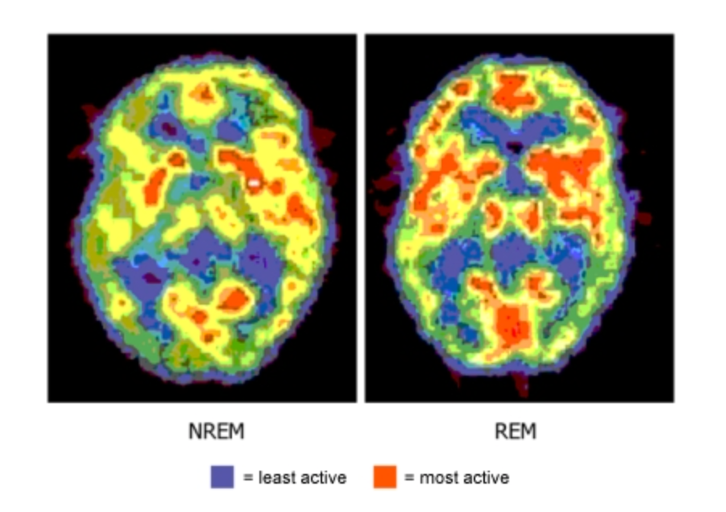

Friston et al. (2017) suggest that fact-free learning can occur not only during sleep but also through reflection (or introspection), which can be both explicit and implicit: “...after acquiring data, a 'good scientist' reflects on what they know (maybe even takes a nap), implicitly testing a series of increasingly simple (less complex and ambiguous) hypotheses that might offer an accurate explanation of the data.” Overall, this emphasizes stillness or non-active reasoning in both body and mind, which may trigger physiological and synaptic processes similar to those in sleep. It could also lead to unusual, novel psychological experiences (or “inputs”), which are hard to explain using existing models and thus increase uncertainty that needs to be resolved: “...just like a sculptor revealing a statue through the careful removal of stone.”
Based on this, the authors propose a hypothesis: they suggest that focused attention (FA) meditation, open monitoring (OM) meditation, and non-dual (ND) meditation all leverage these two inherent possibilities of the brain, allowing it to better manage predictions and achieve balance, calm, and happiness in both body and mind.
The authors then detail their reasoning and experimental process.
FA Meditation (Focused Attention)
FA meditation is typically the starting practice for beginners. It requires focusing attention on a specific sensory object in the present moment, excluding all other distractions. Common objects include the breath, the sensation of walking, a finger’s slow movement, or even the heartbeat—anything that connects you to the present sensory experience. The main goal of this practice is to stabilize attention on the present moment. When distracting or wandering thoughts arise, attention is gently redirected back to the object of meditation. Through repeated practice, meditators develop meta-awareness, allowing them to notice whether they are focused and more easily sustain attention.
FA meditation helps us realize that our experiences are not a completely accurate reflection of reality. From the perspective of predictive processing, FA meditation enhances the precision of attention on the present sensory object while reducing reliance on complex, deep-level predictions. For example, focusing on the breath reduces mental distractions because it lowers the precision of other thoughts. Beginners may struggle to maintain focus for long periods, which decreases the accuracy of sensory signals, making distractions more likely. In contrast, experienced meditators find that distractions and assumptions decrease, and attention becomes more stable. As meditation deepens, the meditator gradually stops engaging in “mind-wandering narratives” (immersing themselves in hypothetical scenarios or stories, similar to daydreaming), and instead becomes more attuned to the present moment.
OM Meditation (Open Monitoring)
OM meditation usually begins after FA meditation has stabilized the mind in the present moment. At this stage, meditators gradually expand their attention in an open, receptive manner, allowing sensory experiences, thoughts, emotions, and other mental events to naturally arise and pass without judgment or reaction. The focus is on cultivating meta-awareness—awareness of one’s thoughts and feelings—without being disturbed by them, easily observing the overall experience, and understanding that all experiences are transient and constantly changing. Here, meditators do not treat thoughts and feelings as distinct objects but view them as a stream of mental activity. No single experience is given excessive attention or precision, and meditators treat all experiences equally. This reduces attachment and clinging to any particular experience, maintaining a quiet, alert, non-judgmental state of observation. In this way, emotional reactions fade, and attention shifts more toward “pure” perception—the state before judgments form. As a result, the brain’s predictions regarding frequency, precision, and time scale shrink, creating more space for background awareness.
Moreover, OM meditation, by continuously observing and letting go (allowing experiences to naturally disappear), can lead to new cognitive insights. If meditators keep observing that all predictions (e.g., thoughts, feelings, sensations) are fleeting and vanish quickly, they may come to understand that these predictions are impermanent. If they realize that all experiences arising in the brain are interpreted by the brain’s systems as pleasant or unpleasant, leading to desires or aversions, they may also recognize the underlying suffering in these experiences. Since these emotions are not intentionally controlled by the meditator, they can come to see that these experiences—and the feelings associated with them—do not have a fixed, unchanging “self” characteristic. This understanding allows them to see the "self" not as a fixed entity but as a process of experience.
ND Meditation (Non-Dual)
ND meditation is gaining increasing attention in the scientific community. FA and OM meditations still maintain a dualistic relationship between the observer and the observed, where the self is observing past experiences. However, in ND meditation, meditators become aware that the distinction between the self and the experience dissolves.
The qualities of ND meditation and non-dual experience are perhaps the hardest to describe within the framework of predictive processing. However, since all psychological experiences are constructed from processes abstracted from the present moment, if meditators truly remain in the present, without constructing models of deep time, a non-dual experience naturally occurs. This means that any mental activity relying on active inference—such as self-awareness or time-related activities—should disappear. In the ND state, even without a self or content, there may still exist some form of basic experience.
Theoretically, the ND state should be “empty,” with no possibility of the type of conscious insight found in OM meditation, because the system no longer constructs deep temporal models. This aligns with teachings in the Heart Sutra, which mentions “no suffering, no cause of suffering, no cessation of suffering, and no path”—seemingly transcending the insights found in OM meditation. The 14th Dalai Lama also emphasized that Mahayana Buddhism focuses on the emptiness of all phenomena, whereas Theravada Buddhism emphasizes the cessation of suffering. Although conscious insights seem impossible in non-dual awareness, the realization that all is empty is a universal insight that can quickly arise once the meditator emerges from the non-dual state, forever changing their experience of the world.
The authors conclude that while FA, OM, and ND meditations are inseparable in many ways and may hold different values in different traditions, they all work together to refine the mind’s predictive processes, leading to a more balanced and enlightened state of being.

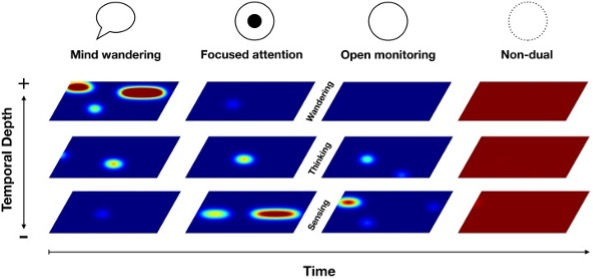
The paper’s core argument is that, from Focused Attention (FA) meditation to Open Monitoring (OM) meditation and finally to Non-Dual (ND) meditation, psychological activity gradually decreases in both time and depth (as shown in the figure above).
First, FA meditation enhances the precision of our current sensory experiences, helping us shift from thinking to perceiving. For example, studies have shown that FA meditation helps reduce mind-wandering, future planning, and self-referential thinking. It also reduces "offline" thinking, which suggests that meditation helps the brain focus more on current sensory input, thereby reducing deep psychological processes that are disconnected from the environment.
Next, OM meditation shifts towards non-judgmental awareness of experiences. This awareness reduces the expected precision of all experiences, making us less likely to react to anything that arises. Research has found that OM meditation significantly reduces the "unpleasantness" of painful experiences, without affecting their intensity. This suggests that OM meditation decreases the time depth of painful experiences.
In ND meditation, even the processes related to sensory classification or semantic processing—which are typically shallow in time depth—may disappear. Meditators enhance the precision of predictions related to the stimulus they focus on, thus reducing their response to unattended stimuli. Additionally, ND meditation may alter the way one perceives the self. As meditation prunes away counterfactual levels, it also prunes self-perception, shifting from a narrative self to a sense of no-self awareness.
"After sensory perception of an object, the mind quickly conceptualizes it based on our past experiences and imposes this conceptualized version onto the originally neutral sensory data—this process happens so fast that we don't notice it, and ultimately, all we are left with is the reality as conceptualized by our brain." (Thrangu, 2011)
Previous research has often focused on how meditation can improve cognition or emotional regulation. However, many meditation systems indicate that the deeper aim of meditation is to understand the "true nature" or "nature of the self," or to gain insight into the nature of reality. These seemingly mysterious aspects are often overlooked in modern science, as they are harder to integrate into secular frameworks. But from the perspective of predictive processing, the deeper meaning of these practices no longer seems mystical. We believe that these practices are the natural result of the state of "living in the present moment." In other words, by focusing on the present, meditation reduces the abstract predictive modeling in the brain, leading to different stages of meditation experiences.
In other words, meditation helps balance the brain's tendency toward hierarchical predictive processing, and this effect aligns closely with the brain's own mechanisms.
When our brain overpredicts thoughts and overthinks, leading to anxiety or tangled negative emotions and behaviors, meditation can bring us back to the present moment. It then expands our awareness to a broader, more neutral, and non-judgmental perspective, allowing us to see insights and viewpoints that we usually miss. We begin to realize that all of our experiences can be like temporary visitors in our minds—naturally appearing and disappearing. Our brain and body become a spacious room, open to these experiences and feelings, inviting them in and allowing them to naturally fade away. We can separate ourselves from these experiences, understanding that they do not belong to "the self." These experiences exist and disappear independently, not bound to the "self."
In non-dual meditation, even this sense of "self" can vanish. Of course, this is a meditation state that most people may not yet be able to experience.
©️Copyright: Please indicate the source 版权所有:转载请注明出处


Comments