Mindful Screen Time Unlocks True Relaxation
- Reed Pryor, Harvard College 2025
- Jan 17, 2025
- 6 min read
Updated: Jan 23, 2025
When you want to relax, are you more likely to close your eyes and meditate, or reach into your pocket for your phone? Many people would choose the phone, whether out of habit or desire for a distraction. A new scientific study, published in December 2023 by researchers from Simmons University in Boston, tried to figure out whether meditation or phone use is more relaxing.
The researchers finished the study with a few main takeaways: 1) We often believe that going on our phones is relaxing, which is one reason why we turn to them so often when we get stressed out. However, going on our phones only stresses us out more, which the researchers found by looking at biological data. Given this, we should look for other relaxation strategies. 2) The relaxing benefits of meditation can be seen even within 5 minutes. Participants who were asked to meditate experienced the biggest increase in relaxation in their first 5 minutes of meditation. This means that you don’t need to invest a lot of time to get the relaxing benefits of meditation. 3) We don’t need to stop all phone use to become less stressed out. Some phone activities are relaxing, like FaceTiming an old friend, while some can be stressful, like scrolling Instagram Reels. A better, and more realistic approach, is to try to combine meditation and phone use. By taking short breaks in your screen time to practice meditation, you might become more aware of which phone activities are relaxing you, and which are stressing you out.
To start out, the scientists wanted to study unstructured phone screen time, which is how you would use your phone if you had a short bit of free time during your day. You might check social media, play a video game, or watch a video. While these activities can be relaxing, the researchers noted that there has been a large amount of new research about the negative effects of too much screen time. For example, some studies have found that using your phone too much increases your risk of becoming depressed, especially for kids and teens. In fact, 54% of teens think that they spend too much time on their phones (Jiang, 2018). Some people clearly want to stop using their phones so much. So what is a different way to spend your time that might be more relaxing?
Meditation is a known method for relaxation, and the researchers thought it could be a good alternative to excessive phone use. One reason is because past studies have shown that people who have meditated less sometimes have more problems with their phone use, like texting while driving or having trouble sleeping. The researchers thought that meditation might help people use their phones in a more healthy way, and it might be a better way to relax than unstructured phone screen time. But how do you measure how relaxed someone is?
The researchers used two different methods to measure the study participants’ relaxation levels. The first method was a self-report survey, which gave the participants a list of adjectives like calm, upset, peaceful, and angry. The participants had to rate how much each adjective described their current mood on a scale from 1-7. For example, if a participant was feeling very relaxed, they would answer a 7 when they saw the word “calm”. The scientists didn’t want to only use self-report data, because sometimes it can be misleading. It can be misleading because people can lie, or sometimes they don’t even know how they are truly feeling. So they added a physical measure of relaxation, which is called heart rate variability (HRV)
HRV is a common way to measure relaxation in scientific research. When you breathe in, your heart usually beats faster, so there’s less time between your heartbeats. When you breathe out, your heart beats slower, so there’s more time between your heartbeats. The difference in time between slow and fast heartbeats is called HRV. An HRV of 67 milliseconds (ms) is shown in the example below - each spike is a new heartbeat, and the time in milliseconds between each heartbeat is shown in black.
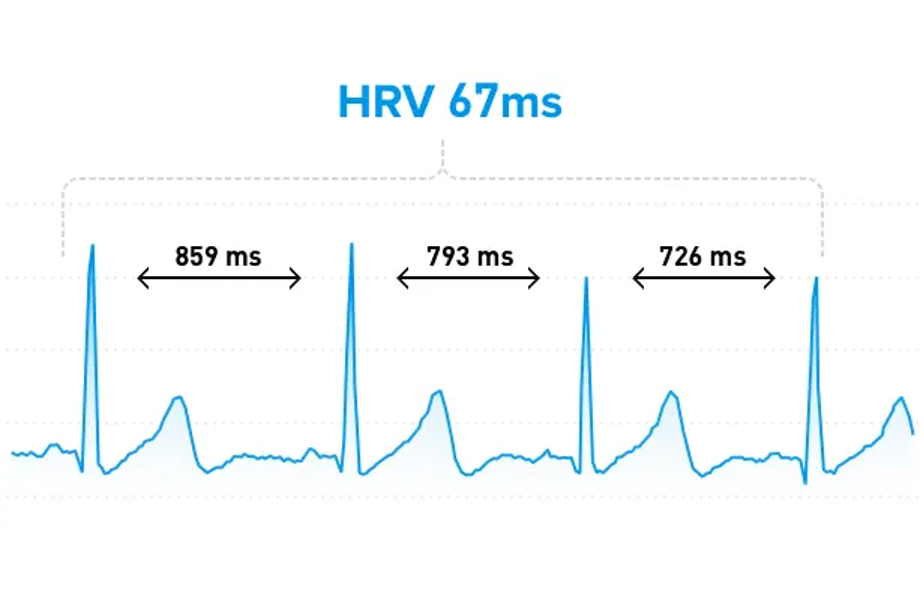
HRV can help measure relaxation because when you are stressed out, your HRV goes down, meaning your heart is beating at a more steady rate. When you are relaxed, your HRV goes up, meaning your heartbeat is slowing down and speeding up all the time. In the past, scientific researchers have done studies which show that your HRV increases when you practice meditation. Because of this, the researchers thought that HRV would be a good way to measure any differences in relaxation caused by screen time and meditation.
To start the study, the researchers gathered a group of 182 women from Simmons University. They attached each of them to an ECG machine, which measures the participants’ HRV using wires stuck on their skin, like below.

Then the researchers told half of the participants to go on their phone for 15 minutes “in whatever way you would normally use it in your daily life whenever you have a bit of free time”; this was the phone group. The researchers gave the other half of the participants a 15-minute guided breathing meditation on audio recording, and called this group the meditation group. During the 15 minutes for both groups, the ECG machine was recording data about the participants’ HRV and how it was changing over time.
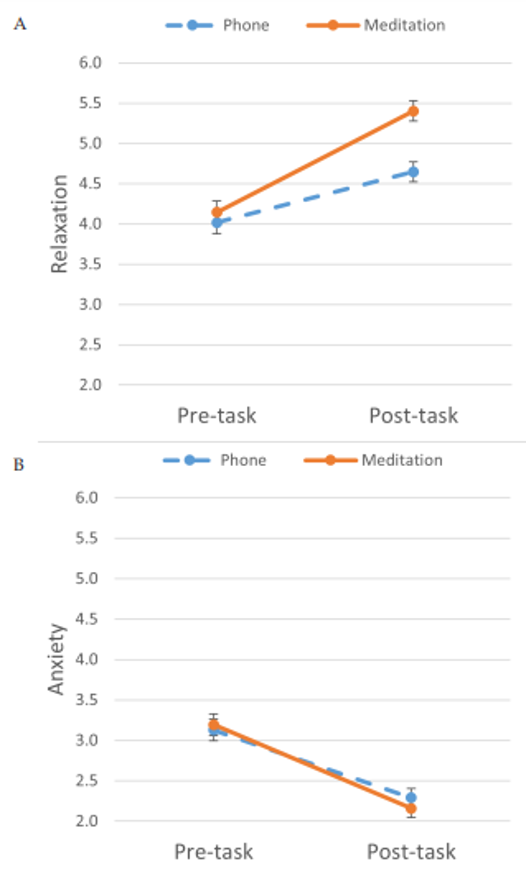
So what did the researchers find out? The first major result was that participants in both the phone and meditation groups self-reported more relaxation and less anxiety. Participants in both groups said they were more calm after the task than before it, but participants in the meditation group experienced a greater increase in their relaxation level than participants in the phone group did.
Similarly, participants in both the phone and meditation groups self-reported less anxiety. From the self-report results, it seems like both going on your phone and meditating relaxes people and reduces their anxiety, but meditating might help a little more. Does the HRV data tell a similar story?

As the graph above shows, there were significant differences in HRV levels between the phone and meditation groups. The researchers found that, while the phone group had higher HRV levels before the 15-minute task, their HRV levels actually decreased throughout their screen time. In contrast, while the meditation group had lower HRV levels before the task, their HRV level increased relative to their baseline level during the 15-minute meditation. Increased HRV usually means more relaxation, while decreased HRV indicates less relaxation. Therefore, the HRV data shows that only participants in the meditation group were more relaxed, while participants in the phone group were less relaxed.
How should we interpret these results? At first, it seems strange that participants self-reported they were more relaxed in both groups, but the physical HRV data implied that only the meditation group was actually more relaxed, while the phone group was less relaxed. One possible explanation is that people think that going on their phone relaxes them, but it actually doesn’t. That would make sense given that people in the phone group reported they were more relaxed when their bodies were showing the opposite.
What should we learn from this study? There are 3 potential lessons to take away:
We might think that our phones relax us, but in fact they make us more stressed, as shown by the HRV data. This means we should look for other ways to relax.
Meditation doesn’t take a long time to start giving you benefits. Participants who were asked to meditate relaxed the most in the first 5 minutes of the session.
Not all phone use is stressful. Combining meditation with phone use might help you to see more clearly which phone activities stress you out, and which ones help you relax.
The researchers of this study aren’t arguing that everyone should stop using their phone. They are trying to tell us that our phones don’t relax us as much as we might think they do, and that meditation might be a better strategy to beat stress. As more and more research is done about meditation and phone use, we will continue to discover more about how we can lead more relaxed and stress-free lives.
©️Copyright: Please indicate the source 版权所有:转载请注明出处


Comments